 Dr. Taha G
Dental implants on the NHS are possible, but only for a small group of patients with a clear clinical need, such as tooth loss after mouth cancer surgery, serious trauma or teeth that never developed. The NHS says implants are usually only available privately. For most adults with missing teeth, the NHS option is a denture or bridge, not an implant.
That answer disappoints many people searching for free dental implants in the UK, so it is worth understanding exactly who qualifies, how referral works and what realistic alternatives exist. If you want to know how implant treatment itself works, our dental implants treatment page explains the process, including 3D CBCT planning.
This guide covers the NHS criteria, the charges for NHS alternatives in 2026, the truth about implant grants, and the private routes people use instead, including treatment abroad.
Can you get dental implants on the NHS?
In most cases, no. The NHS dental treatments page states that implants are "usually only available privately and are expensive". It adds that, although rare, implants are sometimes available on the NHS for patients who cannot wear dentures for certain reasons, for example after mouth cancer or an accident.
The Royal College of Surgeons of England makes the same point in its 2019 guidance on NHS-funded implant treatment. It quotes existing NHS guidance that implants are available on the NHS only if there is a medical need for this type of treatment, and notes the view that implant treatment should not be routinely available on the NHS.
In practice this means that losing a tooth to decay or gum disease, or wanting a fixed alternative to a denture you dislike, does not on its own make you eligible.
Which patients qualify for NHS-funded implants?
The RCS guidance sets out the patient groups that are prioritised for NHS-funded implant treatment:
- inherited or congenital conditions causing missing or malformed teeth, such as hypodontia or cleft lip and palate
- tooth loss following traumatic injury
- tooth and tissue loss from surgery, for example for head and neck cancer
- congenital or acquired defects outside the mouth, such as of the eyes or ears
- people without teeth in one or both jaws where repeated conventional denture treatment has failed
- severe oral mucosal disorders or severe dry mouth where conventional dentures are not possible
- patients lacking suitable teeth for orthodontic anchorage
Belonging to one of these groups does not automatically mean funding is approved. Each case is assessed by a specialist, usually in a hospital restorative dentistry department, and local commissioning rules and waiting lists apply.
How does an NHS referral for implants work?
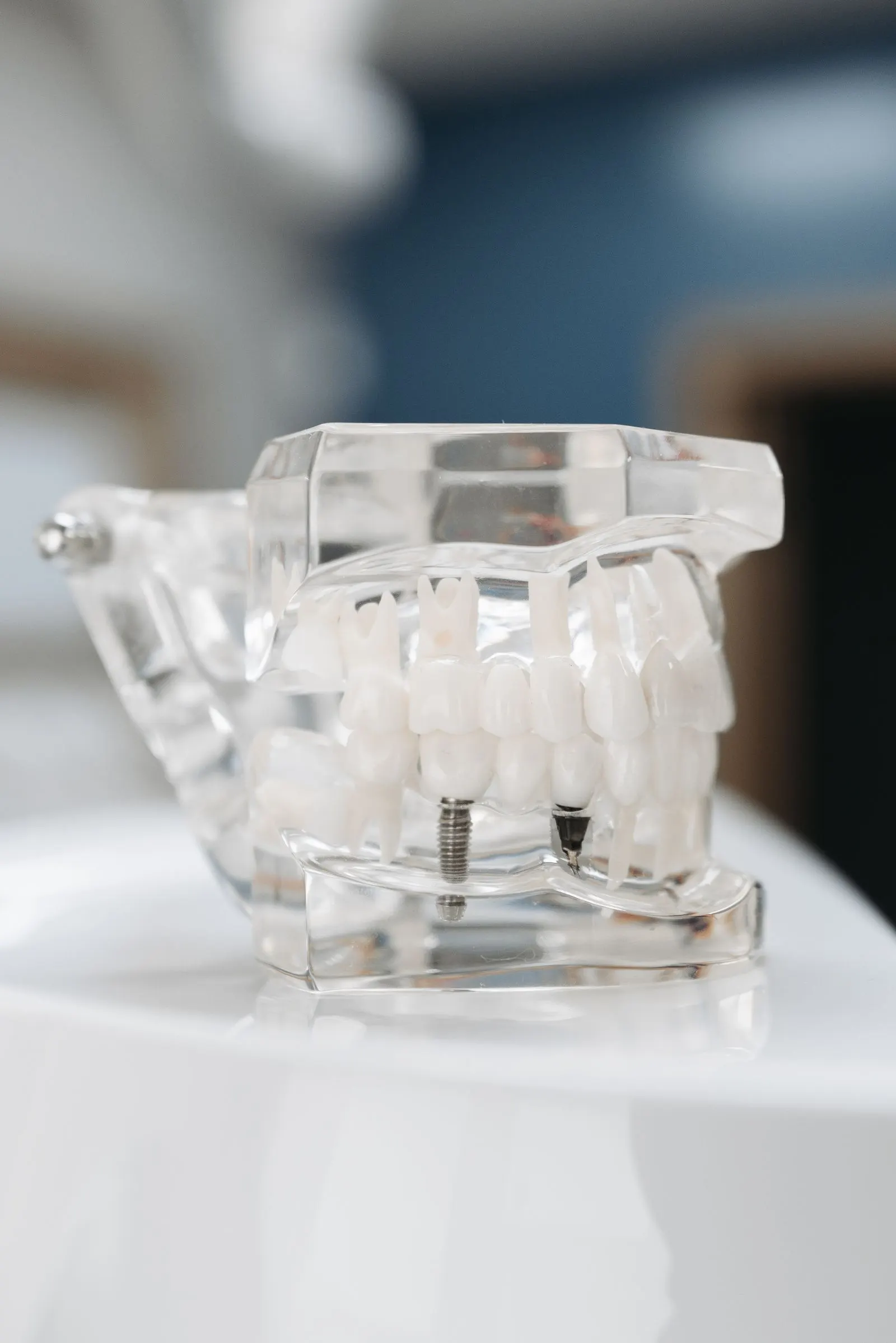
You cannot refer yourself. The first step is an assessment by a general dentist, who decides whether a specialist referral is clinically appropriate. Newcastle Dental Hospital's patient FAQ describes this route: implant-based treatment is available to NHS patients "in specific circumstances", and the referring dentist must make the referral before the hospital arranges an assessment.
If you think you may fall into one of the priority groups, ask your dentist directly whether a referral to a restorative dentistry service is appropriate, and ask for the outcome in writing.
It helps to go to that appointment prepared. Bring any hospital letters about cancer treatment, an accident or a diagnosed condition such as hypodontia, and a short history of the dentures you have tried and why they failed. A referral is a clinical judgement, so a "no" usually means your situation does not match the criteria rather than that the paperwork was wrong. If you disagree with the decision, you can ask your dentist to explain the reasons, and you can ask for a second opinion from another NHS dentist.
Even when a referral is accepted, the hospital team may conclude that a conventional denture or bridge is the safest option for you. Implants need enough healthy bone, good gum health and a commitment to long-term cleaning and review.
What does the NHS offer instead of implants?
For most people, the NHS replaces missing teeth with dentures or bridges. These fall under Band 3 of NHS dental charges in England. According to the NHS Business Services Authority, the charges from 1 April 2026 are:
| NHS band (England) | Charge from 1 April 2026 | What it covers |
|---|---|---|
| Band 1 | £27.90 | Examination, X-rays if clinically needed, simple gum care such as scaling |
| Band 2 | £76.60 | Band 1 plus fillings, root canal treatment, extractions |
| Band 3 | £332.10 | Bands 1 and 2 plus crowns, bridges and dentures |
| Urgent treatment | £27.90 | Emergency assessment and urgent care |
The NHS charges page explains that you pay the highest band needed for a course of treatment, not each band separately. Implants do not appear in any NHS band.
A well-made denture or bridge is a legitimate solution, not just a cheaper compromise. For some people a conventional denture suits their health and budget better than surgery. What NHS and private dentures actually cost, from Band 3 to chrome partials, is set out in our guide to dentures cost in the UK.
Are there government grants for dental implants in the UK?
We could not find any UK government grant scheme that pays for private dental implants. Many websites rank for "government grants for dental implants UK" or "how to get free dental implants UK", but the official help that exists is linked to NHS treatment.
According to the NHS page on who can get free NHS dental treatment, free treatment is available to groups including under-18s, people under 19 in full-time education, pregnant women and those who have had a baby in the last 12 months, and people receiving certain benefits. The NHS Low Income Scheme can help with part or all of NHS charges. The same page states clearly that you will need to pay for any private dental treatment.
So "free dental implants for low income UK" is not something these schemes provide. If you qualify for help with NHS costs, that help applies to NHS dentures, bridges and crowns, or to implants only in the rare cases where the NHS itself funds them.
Can a dental hospital or dental school help?
Teaching hospitals do treat NHS patients, and some routine work is carried out by supervised students. Newcastle Dental Hospital notes that routine, less complex restorative work may be provided by undergraduate students for teaching purposes, and that its availability depends on teaching needs. Implant treatment in these settings still follows the clinical criteria and referral route described above.
Some university hospitals occasionally recruit patients for research. If you are interested, ask your dentist whether any local studies are relevant, and read the participant information carefully before agreeing to anything.

How much do full mouth implants cost if the NHS does not pay?
Full mouth implants are not priced on the NHS, because they are only funded in exceptional clinical cases. Privately, the cost depends on how many implants are needed, whether bone grafting is required and what kind of teeth are attached. Our guide to dental implant costs in the UK explains how UK private fees are structured.
At our clinic in Istanbul, the starting prices in our price table are:
| Treatment | Starting price at Doctor Turka |
|---|---|
| Single implant | from €235 per implant |
| All-on-4 | from €3,310 per arch |
| All-on-6 | from €3,775 per arch |
| Bridge | from €460 per bridge |
These are starting prices only. The final price depends on your examination and scans and is stated in your written treatment plan. For a full breakdown, including what is and is not included, see our implant cost guide for Turkey and our dental costs in Turkey page.
What are the realistic options if you do not qualify?
If NHS implant funding is not available to you, the realistic routes are:
- NHS dentures or bridges under Band 3, possibly with help from the NHS Low Income Scheme.
- Private implants in the UK, sometimes paid in instalments if a practice offers finance. Read the credit terms carefully.
- Treatment abroad, which can lower the cost but requires travel and careful planning.
Be realistic about treatment abroad. NHS help does not cover it, and follow-up care needs to be planned before you go: implants need more than one stage, healing time between visits, and check-ups afterwards. Ask any clinic, including ours, for a written plan that states the number of implants, the type of teeth fitted, the number of visits and what happens if a problem arises.
Dental implants in Istanbul with Doctor Turka
Our dentists at Doctor Turka in Ataköy, Bakırköy, Istanbul, plan implant treatment with 3D CBCT imaging and explain honestly when a denture or bridge may be the better choice. You receive a free written treatment plan before you travel. Read how the process works or contact us via WhatsApp or our contact page.
Sources
- Dental treatments (NHS)
- Understanding NHS dental charges (NHS)
- View the current NHS dental charges (NHS Business Services Authority)
- Who can get free NHS dental treatment (NHS)
- Guidance on the standards of care for NHS-funded dental implant treatment (Royal College of Surgeons of England, 2019)
- Dental Hospital: frequently asked questions (Newcastle upon Tyne Hospitals NHS Foundation Trust)
Want a personal opinion?
Leave your contact details. Our patient coordinator will contact you to discuss your needs and explain the next steps, free and without obligation.
Discuss my options