 Dr. Hatice G
Few celebrity smiles have caused as much debate among dentists as Kanye West's titanium teeth. Photos of the rapper, who now goes by Ye, showing a mouth covered in polished grey metal were widely shared in January 2024. Reports put the price at more than $850,000, and the look was widely compared to Jaws, the steel-toothed villain from the James Bond films.
This article separates what has been reported from what is speculation, explains what a titanium dental prosthesis actually is, and then does what a responsible dentist would do: walk through the options for someone who wants a dramatic, lasting change to their smile without sacrificing healthy teeth.
What Kanye West reportedly had done
What is publicly known comes from his own social media posts and from media interviews given by his Beverly Hills dentist. According to those reports:
- The visible surfaces are made largely of titanium, milled to his specifications rather than cast in gold like traditional grillz.
- His representatives described the work as titanium dentures, the Beverly Hills dentist involved presented it as art, and the look was widely compared to the Jaws character from the Bond films.
- The widely quoted price tag was more than $850,000, which would make it far more expensive than any conventional full-mouth restoration.
- Earlier in his career, Ye had worn gold and diamond grillz, and he has spoken about having had extensive dental work over the years.
What is not clearly established is whether any natural teeth were removed, whether the prosthesis is fixed or can be taken out, and what sits underneath it. Reports and online commentary have contradicted each other on these points. So rather than guess, it is more useful to look at what "titanium teeth" can mean in practice.
Denture, grillz or bridge? Three things titanium teeth can be
The word denture is doing a lot of work in the headlines. In dentistry it has a precise meaning: a removable prosthesis that rests on the gums or clips onto implants. A grill is a decorative removable cover over existing teeth. A bridge is fixed. These are very different things for the mouth underneath.
| Type | How it attaches | What happens to your own teeth | Reversible? |
|---|---|---|---|
| Removable grill / overlay | Snaps over the existing teeth like a thin shell | Usually nothing, or very light adjustment | Yes, take it out |
| Fixed full-arch bridge on natural teeth | Cemented onto teeth that have been reduced to posts | Every tooth is ground down by 1.5-2 mm or more | No |
| Implant-supported full-arch bridge | Screwed onto 4-8 titanium implants in the jaw | Remaining teeth are extracted | No |
| Conventional denture | Rests on the gums, held by suction or adhesive | Teeth already missing or extracted | Removable, but the teeth are gone |
If Ye's set is a removable overlay, the dental consequences are limited to hygiene and wear. If it is a fixed full-arch construction, the consequences are permanent. That is the distinction almost nobody made in the viral coverage.
Titanium in dentistry: where it belongs
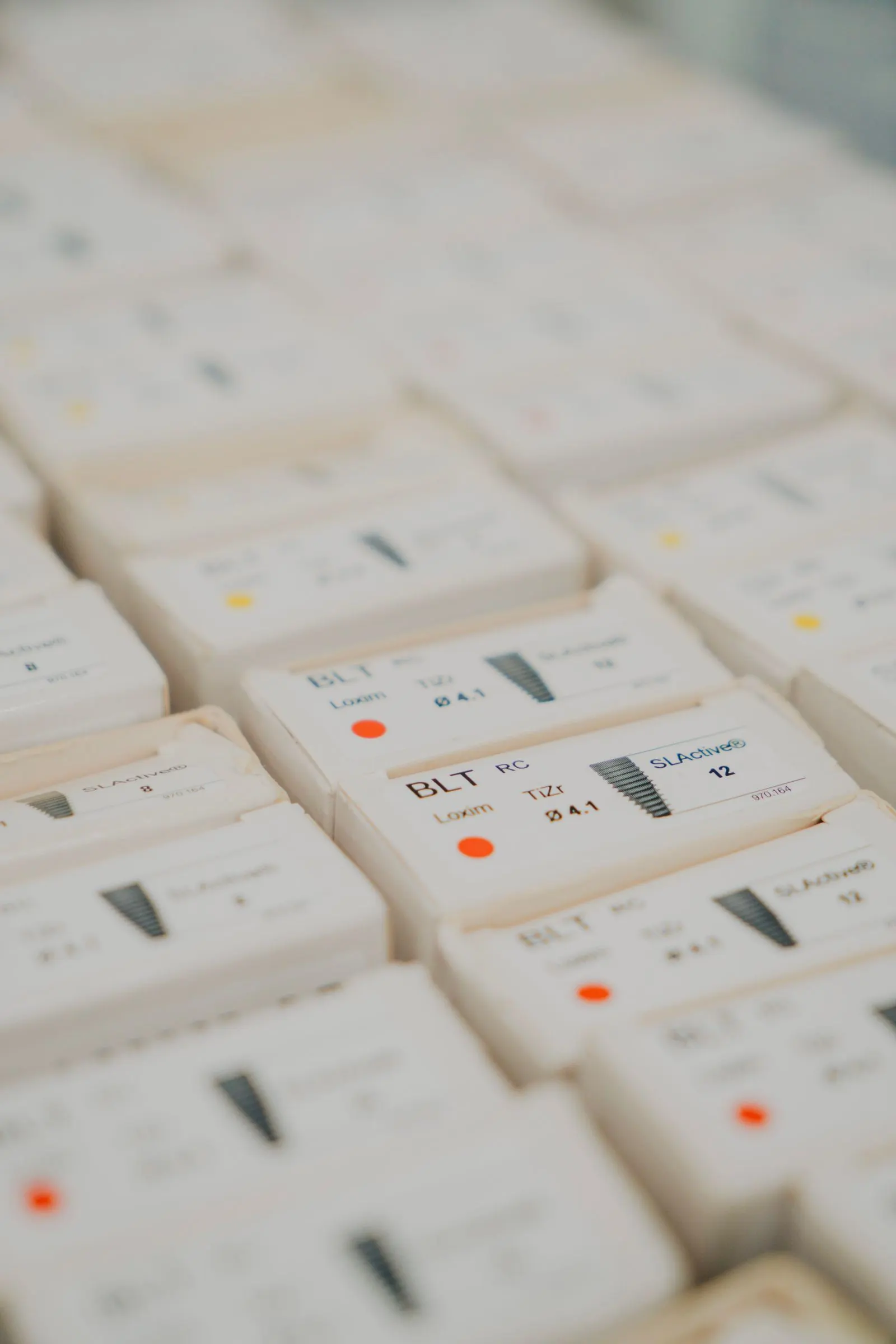
Titanium is one of the most important materials in modern dentistry, just not usually on show. It is biocompatible, corrosion resistant and bonds directly with bone through a process called osseointegration. That is why almost every dental implant post, including systems such as Nobel Biocare, Straumann, Osstem or Swiss Implant, is made from titanium or a titanium alloy.
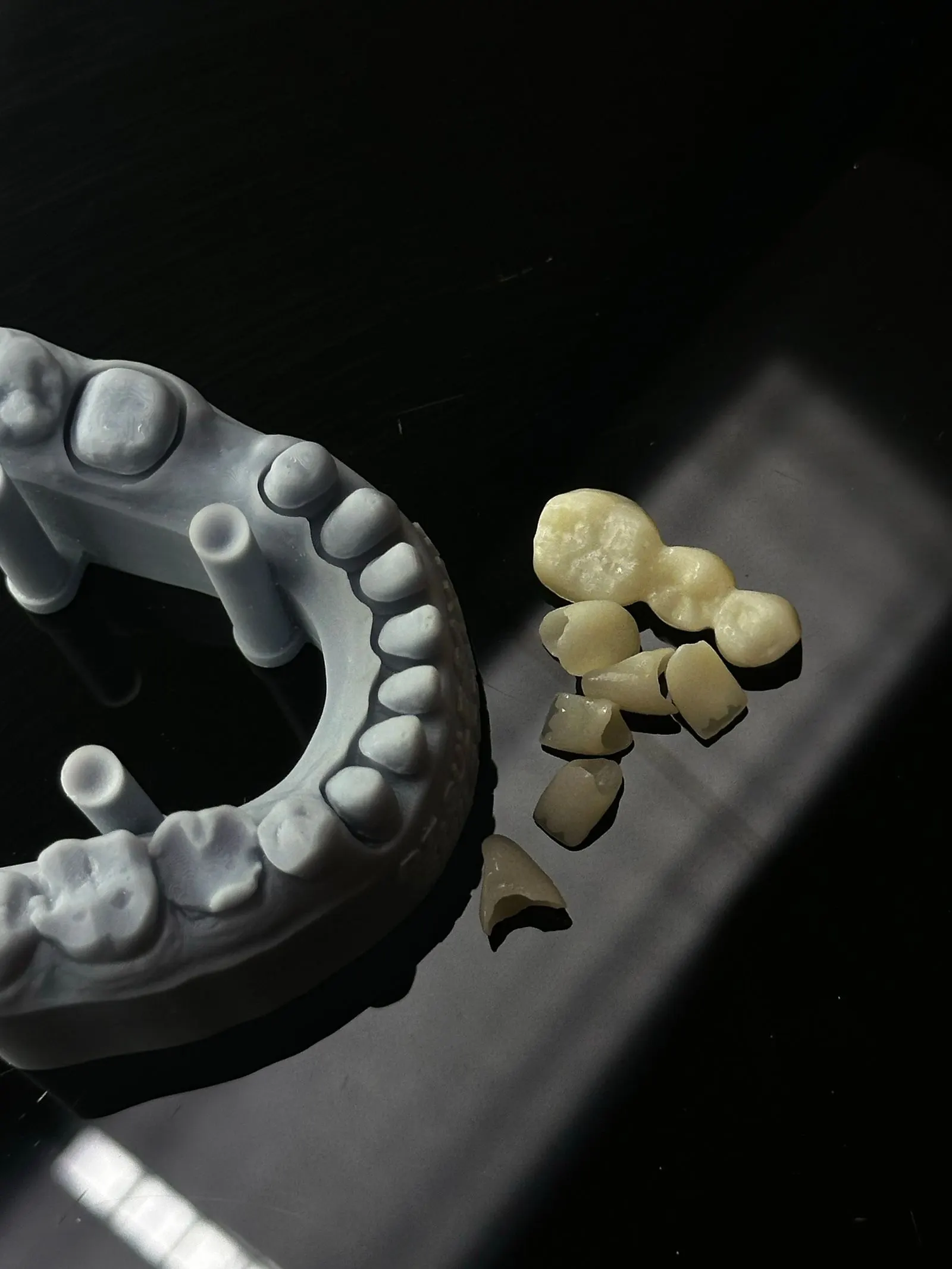
Titanium is also used for milled bars and frameworks inside implant bridges, where its strength and low weight help. In those cases it is covered by zirconia or acrylic teeth. Using titanium as the visible biting surface is unusual for several reasons:
- It does not look like enamel. The grey tone cannot be shade-matched or blended with natural teeth.
- It shows wear and scratches. Polished titanium picks up fine marks from food and brushing over time.
- It conducts temperature more than ceramic, which some patients notice with hot and cold drinks.
- It is hard to repair in place. Chipped ceramic can often be polished or bonded; a damaged metal framework usually needs remaking.
None of this makes titanium dangerous. It makes it an unusual aesthetic choice, and one that commits you to a look that cannot be adjusted gradually.
What a fixed full-arch restoration means for the teeth underneath
If a set of teeth is cemented permanently onto natural teeth, those teeth have to be prepared. The dentist removes a shell of enamel and dentine, typically 1.5-2 mm all around, so the new crown or framework can sit over the tooth without looking bulky.
On a single tooth that is routine. On every tooth in both arches it is a major, irreversible step:
- Enamel does not grow back. Once a tooth has been reduced to a core, it will need a crown for the rest of its life.
- The nerve is put under stress. Studies on full-crown preparations report that a meaningful minority of prepared vital teeth later need root canal treatment, and the risk rises with aggressive reduction.
- Each replacement removes more. Crowns and bridges do not last forever. Every remake takes a little more tooth, until eventually there may not be enough left to hold anything.
For someone whose teeth are already heavily crowned or damaged, this calculation is different. That is why dentists stress that a restoration like Ye's might be a reasonable choice for one person and a harmful one for another. It all depends on what is underneath.
Why dentists were uneasy about the trend
When the photos went viral, many dentists commented publicly. Their concerns were less about Ye himself, whose dental history nobody outside his treatment team knows, and more about fans copying the look.
- Irreversible treatment for a fashion choice. Styles change; ground-down teeth do not recover.
- Hygiene around full-coverage metal. Fixed full-arch work is harder to clean. Plaque trapped at the margins can inflame the gums and cause decay under the framework.
- Bite and jaw load. A full set of new biting surfaces changes the way the jaws meet. Without careful bite planning it can lead to jaw pain, headaches or fractures.
- Social media copies. Cheap, poorly fitting metal covers bought online, or worn day and night, can trap food and bacteria against the teeth.
If you like the aesthetic, the dentally safe way to wear it is a removable grill made from a proper impression or scan, worn for occasions and cleaned carefully, not a permanent reconstruction. The same applies to snap-on smiles; our guide to clip on veneers vs real veneers explains their limits and risks.
The modern alternatives for a dramatic smile change
Most people who want a new smile are not after metal. They want teeth that are brighter, straighter, more even and durable. Here the modern options compare like this:
| Option | Best for | Tooth reduction | Typical lifespan in studies | Look |
|---|---|---|---|---|
| Porcelain veneers (E.max) | Healthy teeth with colour, shape or small spacing issues | 0.3-0.7 mm on the front surface | Often 10-15+ years | Translucent, enamel-like |
| Zirconia crowns | Heavily filled, cracked or root-treated teeth; grinders | 1-1.5 mm all around | 10-15+ years | Tooth-coloured, very strong |
| Implants with a zirconia bridge (All-on-4 / All-on-6) | Missing or unsaveable teeth in a whole arch | Remaining teeth removed | Implant survival above 95 % at 10 years in many studies | Fixed, natural-looking teeth |
| Titanium full-arch cover | Statement look | Depends on design: none (removable) to full preparation | Little clinical data | Grey metal |
In short: titanium does the heavy lifting inside the bone, ceramic does the visible work. A combination often gives the best result, for example implants where teeth are lost, crowns where teeth are damaged and veneers where teeth are healthy.
How a full-arch smile is planned responsibly in Istanbul
If you are considering a large change, whether veneers on 16-20 teeth, a set of crowns or an implant bridge, the planning matters more than the material. At Doctor Turka the process runs like this:
- Contact. You leave your contact details and a patient coordinator, who speaks English and German, calls or writes to understand what you want and your dental history. If you already have a recent X-ray it can be useful, but it is not required.
- Assessment in the clinic. On the first day in Istanbul a dentist examines you and takes a 3D CBCT scan. This shows bone, roots, old root fillings and hidden decay, which is exactly the information that decides between veneers, crowns and implants.
- Written, itemised plan. You receive a plan listing every tooth, the material, the number of trips and the quote. You can take the time you need to decide.
- Digital design and mock-up. Before anything is permanent you see and try the proposed shape and shade in your own mouth.
- Treatment. Veneers and crowns usually take one trip of about 5-7 days. Implant bridges usually need two trips: surgery and temporary teeth first, then the final bridge after the bone has healed, typically 3-6 months later.
- Follow-up from home. Check-ups and cleaning can be done by your local dentist, and your coordinator remains your point of contact.
See how it works for the full timeline, including hotel nights and airport-hotel-clinic transfers.
Lifespan and maintenance of full-mouth work
Whatever the material, extensive dental work lasts longest when it is maintained like natural teeth, with more care around the joins.
- Brush twice daily and clean between teeth with interdental brushes or a water flosser, especially along the gum line of crowns and bridges.
- See a hygienist every 3-6 months. Implant bridges benefit from professional cleaning around the implants.
- Wear a night guard if you grind. Grinding is one of the most common reasons ceramic chips or implant screws loosen.
- Report any looseness, bad taste or bleeding early. Small problems are easy to fix; ignored ones become remakes.
What to ask any clinic before a full-mouth change
A celebrity can return to the same dentist whenever something goes wrong. Most patients cannot, so it pays to ask the right questions up front:
- Which teeth will be veneered, which crowned, which left alone, and why?
- How much tooth will be removed on each tooth?
- Will I see and approve a mock-up before preparation?
- Which ceramic and implant brands will be used, and will I get the details in writing?
- What does the written guarantee cover, and what happens if something fails after I get home?
- Who is my contact after treatment?
Red flags include one standard plan for everyone, crowns proposed on healthy teeth for speed, no 3D scan before implants and pressure to decide on the day.
Market prices at home compared with Turkey
Because the reported $850,000 figure has nothing to do with normal dentistry, it helps to look at typical private fees. Commonly quoted ranges are roughly:
- United States: $1,000-2,500 per porcelain veneer or crown; a full-arch implant bridge often $20,000-35,000 per jaw.
- United Kingdom: £600-1,200 per veneer or crown; a full-arch implant bridge often £12,000-25,000 per jaw.
- Germany: €800-1,500 per veneer or crown privately; a full-arch implant bridge often €15,000-25,000 per jaw.
Istanbul is priced per tooth and per implant with the same brands of ceramic and implants, which is why many patients from the UK and Europe travel. Our current starting prices are on the costs page. For more on how the cheap end of the market goes wrong, read Turkey teeth: what it means and how to avoid it.
The takeaway
Kanye West's titanium teeth are a fashion statement built with dental materials. Whether his set is a removable piece or a permanent reconstruction, it is not a treatment plan most people should copy. If you want a striking, lasting smile, the proven approach is simple: keep titanium in the bone where it is needed, put ceramic on show, preserve as much natural tooth as possible and insist on seeing the design before anything is fixed.
Doctor Turka has not treated the person named in this article. Details about their dental work come from public interviews and media reports; we comment only on what the treatments involve in general.
Sources
- Kanye West's 'titanium teeth' are permanent, rep says (TODAY.com, NBC News)
- The whole tooth behind Kanye West's 'titanium dentures' (1News, TVNZ)
- Ye's titanium teeth: How would they fare as teeth? Experts weigh in (Northeastern Global News)
- Long-term (10-year) dental implant survival: A systematic review and sensitivity meta-analysis (Howe et al., Journal of Dentistry 2019)
Want a personal opinion?
Leave your contact details. Our patient coordinator will contact you to discuss your needs and explain the next steps, free and without obligation.
Discuss my options